
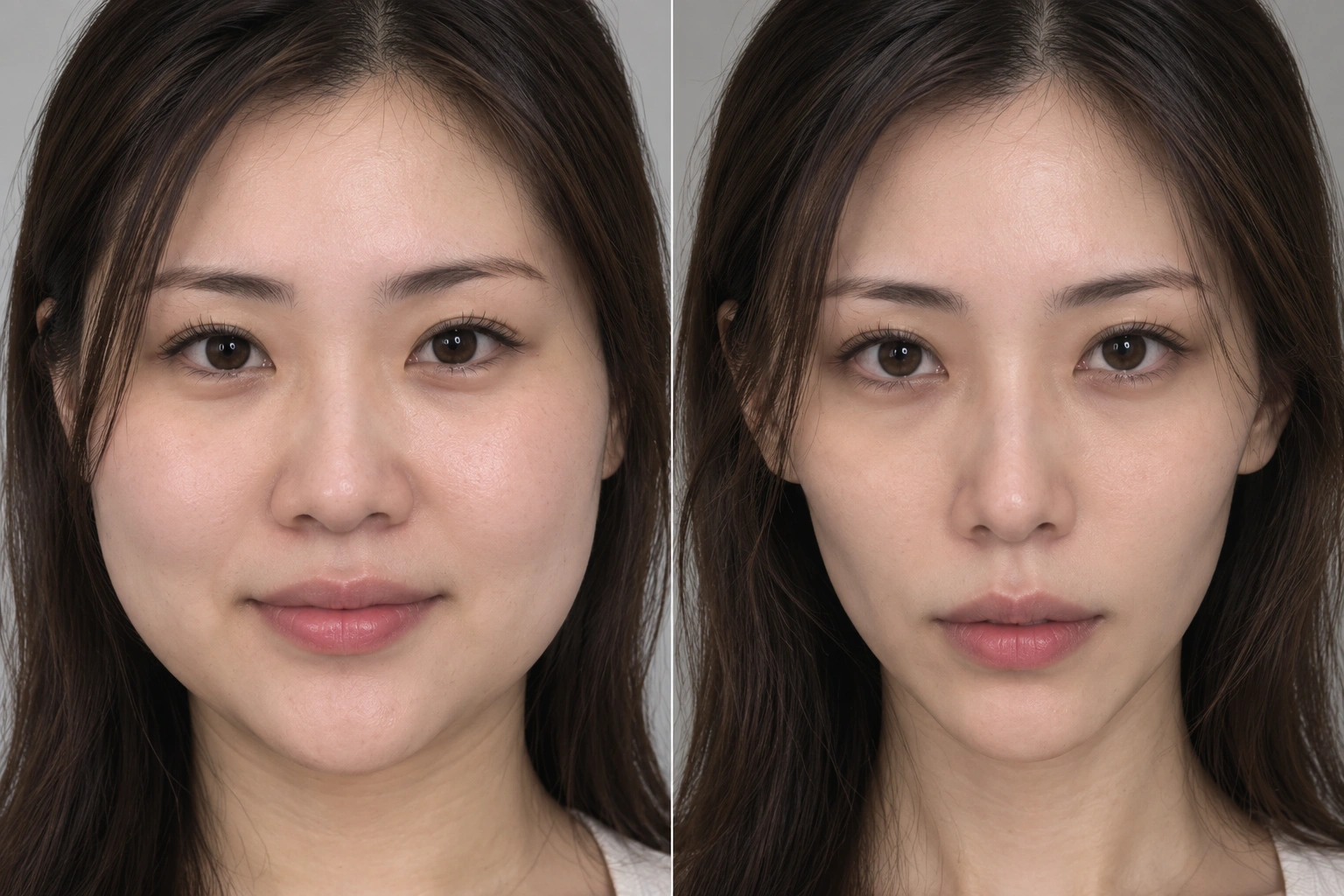

Quick Answer: “Ozempic face” describes facial volume loss — sunken cheeks, hollow temples, sagging skin, and more visible wrinkles — that can follow rapid weight loss on GLP-1 medications like Ozempic. It isn’t a direct drug side effect. The same changes occur with any rapid weight loss, regardless of method. It can be limited by losing weight more gradually, and treated with dermal fillers, skin boosters, or collagen-stimulating treatments.
What Is Ozempic Face?
“Ozempic face” is an informal term, not a medical diagnosis. It describes a cluster of facial changes that can appear after significant, rapid weight loss:
- Sunken or hollow cheeks
- Hollowing at the temples
- Loose or sagging skin, particularly along the jawline
- More visible fine lines and wrinkles
- Under-eye hollowing and deeper tear troughs
- A generally gaunt or older appearance
According to Cleveland Clinic, it refers to facial volume loss from rapid weight loss, causing sunken cheeks, wrinkles, and an older look.
The frustrating part for most people: your body may look considerably better while your face looks noticeably worse.
Is Ozempic Face Actually Caused by Ozempic?
No — and this is the most important thing to understand about it.
There’s no evidence that semaglutide or any GLP-1 medication causes these facial changes directly. A 2025 review in the Journal of Clinical Medicine states the term describes facial ageing changes following rapid weight loss regardless of whether the weight reduction came from medication or voluntary calorie restriction.
The drug isn’t doing anything to your face. Rapid weight loss is.
The same changes have always occurred after bariatric surgery, crash dieting, or any substantial weight loss achieved quickly. Ozempic simply made rapid weight loss achievable for far more people, so the effect became visible enough to earn a nickname.
Why this matters practically: switching medications won’t prevent it. Slowing the rate of loss might.
Why Does It Happen?
Two mechanisms, working together.
1. Loss of Facial Fat
Your face contains distinct fat compartments that provide structure and youthful fullness — in the cheeks, temples, around the eyes, and along the jawline.
Fat loss isn’t something you can direct to specific body parts. When you lose weight, you lose it from these facial compartments too. The face is also one of the first places it becomes visible, because there’s relatively little fat there to begin with.
Our guide on how weight loss affects your face covers this in more detail.
2. Skin That Can’t Keep Up
Skin has a limited ability to retract after being stretched. Lose weight slowly and it has time to adapt. Lose it quickly and the skin that previously covered a fuller face now has nothing supporting it.
Collagen and elastin matter here. Both decline naturally with age, so the older you are, the less your skin can bounce back — which is why Ozempic face tends to be more pronounced in people over 40. Our guide on sagging skin: causes and treatment explains the underlying mechanism.
Who Is Most at Risk?
You’re more likely to notice significant facial changes if you:
- Lose weight rapidly — the single biggest factor
- Are over 40, when collagen and elastin production has already declined
- Lose a large amount of total weight
- Were already lean-faced before starting
- Have naturally thinner skin or lower baseline facial volume
- Have significant sun damage, which has already degraded collagen
- Smoke, which accelerates collagen breakdown
How to Prevent or Limit Ozempic Face
You can’t eliminate facial volume loss entirely if you’re losing significant weight. You can meaningfully reduce how noticeable it becomes.
Lose Weight More Gradually
The most effective prevention. Aim for 0.5 to 1kg per week rather than the fastest possible rate. This gives skin time to adapt rather than being left behind.
If your rate of loss is faster than this, discuss dose adjustment with your prescribing doctor. Slower isn’t a failure — it produces a better overall outcome. Our guide on how to lose weight fast and safely covers what a sustainable rate actually looks like.
Prioritise Protein
Adequate protein helps preserve muscle mass during a calorie deficit, and supports collagen production. Under-eating protein while in a deficit accelerates both muscle and structural loss.
If you’re unsure what your actual intake should be, our calorie calculator guide covers working out your requirements.
Support Collagen From Within
Collagen peptide supplements are worth understanding honestly — the evidence is moderate rather than dramatic, but they’re low-risk. Our review of the best collagen supplements covers what to look for.
Protect Your Collagen Externally
Daily sunscreen is the single most effective anti-ageing intervention available, and it matters more when your skin is already under strain. Our guide on physical vs chemical sunscreen covers choosing one.
Topical retinoids support collagen production over time and are worth starting before or during weight loss rather than after — our tretinoin guide covers the prescription-strength option.
How to Treat Ozempic Face
Once volume is lost, prevention is no longer the question. A 2025 systematic review published in PubMed Central found that the facial volume loss seen with Ozempic face can be addressed with dermal fillers or fat grafting to the temples, tear troughs, cheeks, and nasolabial folds.
Dermal Fillers
The most direct approach. Dermal fillers replace lost volume where it’s been lost — cheeks, temples, tear troughs, and along the jawline.
Best for: visible hollowing and structural volume loss. Results: immediate, lasting 6 to 18 months depending on area and product.
Our guides cover the best facial fillers in Malaysia, how long fillers last by area, why some fillers look more natural, and a full comparison of filler brands.
For under-eye hollowing specifically, see our guides on dark circles and under-eye treatment and Electri vs under-eye filler.
Skin Boosters
Where the issue is skin quality — crepey texture, dullness, loss of elasticity — rather than pure volume, skin boosters deliver hydration and stimulate collagen within the dermis.
Best for: texture, elasticity, and overall skin quality. Results: gradual, building over 2 to 3 sessions.
Our guide on skin booster vs dermal filler explains which addresses which problem.
Collagen-Stimulating Treatments
Treatments like Rejuran and biostimulators work by prompting your own collagen production rather than adding volume directly. Slower than fillers, but the improvement is structural rather than borrowed.
Best for: longer-term skin quality restoration.
Skin Tightening
For loose skin rather than lost volume, energy-based treatments stimulate collagen at depth to tighten mild to moderate laxity.
Best for: sagging along the jawline and neck. Results: gradual, over 2 to 3 months.
Our guide on the 10 best skin tightening treatments in Malaysia covers the full range, and Ultherapy PRIME vs thread lift compares two of the most common options. If neck laxity is your main concern, see our guide on turkey neck: causes and treatment.
Which Treatment Is Right?
| Your main concern | Likely approach |
|---|---|
| Hollow cheeks or temples | Dermal filler |
| Under-eye hollowing | Tear trough filler |
| Crepey, dull skin texture | Skin booster |
| Loose skin along the jawline | HIFU or Ultherapy |
| Sagging along the neck | Skin tightening |
| Deeper folds around the mouth | Filler, see marionette lines |
| More visible fine lines | See wrinkles and fine lines |
Most people present with a combination, which usually means a combination approach rather than one treatment.
Should I Stop Taking Ozempic?
This isn’t a decision to make based on how your face looks, and not one to make alone.
If you’re taking Ozempic for type 2 diabetes, stopping affects your blood sugar control — a considerably more serious matter than facial volume.
If you’re taking it for weight management and facial changes are bothering you, the better conversation with your doctor is usually about rate of loss rather than stopping entirely. Adjusting the dose to slow weight loss addresses the actual cause.
Stopping also tends to lead to weight regain, which may partially restore facial volume, but rarely in the way people hope, and at the cost of losing the health benefits.
Talk to your prescribing doctor before changing anything.
Frequently Asked Questions
Is Ozempic face permanent? The volume loss itself doesn’t reverse on its own, since the facial fat is genuinely gone. Some people see partial restoration if they regain weight. Treatment with fillers or collagen stimulators can restore the appearance effectively.
How long does it take for Ozempic face to appear? Typically after several months of significant weight loss, though it varies with how quickly you lose and how much. Some notice changes within 8 to 12 weeks.
Does Ozempic face happen to everyone? No. It depends on how much weight you lose, how fast, your age, and your baseline facial fullness. Younger people losing weight gradually often see minimal change.
Can Ozempic face be reversed naturally? Not substantially. Once facial fat is lost, it doesn’t return unless you regain weight. Hydration, protein, and skincare help the skin look better but can’t restore lost volume.
Is Ozempic face the same as looking older? The changes mimic facial ageing — volume loss, hollowing, more visible lines — which is why people often say they look older rather than just thinner.
Does it happen with Wegovy, Mounjaro, or Saxenda too? Yes. It isn’t specific to Ozempic. Any medication or method producing rapid weight loss can cause the same facial changes.
Can I prevent it while still losing weight? You can reduce it. Lose weight more gradually, prioritise protein, maintain strength training, and protect your skin. You can’t eliminate facial fat loss entirely while losing significant weight.
Should I get filler while still losing weight? Generally better to wait until your weight has stabilised, since continued loss will change the result. Discuss timing with your doctor — for some people treating during the process makes sense, but stability usually produces better outcomes.
Bottom Line
Ozempic face isn’t a drug side effect. It’s what rapid weight loss does to a face, and it would happen the same way through crash dieting or bariatric surgery.
That reframing matters, because it points to the actual solution: the rate of weight loss is the variable you can control, not which medication you’re on.
If volume has already been lost, it’s treatable — dermal fillers, skin boosters, and collagen-stimulating treatments all address different aspects of it, and most people benefit from a combination.
At CLÉO Clinic, facial assessments are carried out by LCP-certified doctors who can identify whether your concern is volume loss, skin laxity, texture, or a combination — and recommend accordingly. See our treatable conditions, or book a consultation.


