

Table of Contents
- Lip Anatomy 101
- Common Lip Shapes
- Full Lips
- Thin Lips
- Round Lips
- Heart-Shaped Lips
- Wide Lips
- Downturned Lips
- Uneven or Asymmetrical Lips
- Wide-Set vs. Close-Set Lips
- Filler-Specific Lip Shape Terms
- How to Determine Your Own Lip Shape
- How Lips Change With Age (Lip Line Types)
- Lip Shape and Dermal Filler: Matching Technique to Your Natural Shape
- Frequently Asked Questions
- Bottom Line
No two lips are exactly alike — genetics, ethnicity, age, and even facial expression habits all shape how your lips look. Understanding your own lip shape isn’t just useful for choosing a lipstick or liner; it’s also the starting point for any conversation about lip filler, since the best results come from enhancing your natural shape rather than working against it.
This guide covers the real anatomy behind your lips, the most common lip shapes, how lips change with age, and how each shape typically factors into filler planning.
Lip Anatomy 101
Quick Answer: Lips are made up of several distinct anatomical landmarks — the vermilion border, Cupid’s bow, philtrum, tubercles, and oral commissures — and understanding these is what allows a doctor to enhance your lips in a way that looks proportionate rather than artificial.
- Vermilion border – the defined line where your lip meets the surrounding facial skin; this is the line most people follow with lip liner, and one of the most important landmarks in filler planning
- Cupid’s bow – the double-curve shape at the center of your upper lip’s vermilion border, named for its resemblance to an archer’s bow
- Philtrum – the vertical groove running from the base of your nose to the center of your upper lip, framed by two raised ridges called philtral columns, with a slight dimple (the philtral dimple) between them
- Tubercles – small, naturally raised areas of fullness; most people have three on the upper lip (one central, two lateral) and two on the lower lip, which together create the lips’ outward projection and fullness
- Oral (labial) commissures – the corners of your mouth, where the upper and lower lips meet
- Labiomental groove – the crease between your lower lip and chin
According to Cleveland Clinic, the medical term for the lips is “labia oris,” with the upper lip called the labium superius and the lower lip the labium inferius — both shaped and supported by the underlying orbicularis oris muscle, which forms an oval ring around the mouth and controls lip movement.
Common Lip Shapes
Quick Answer: The most commonly described natural lip shapes include full, thin, round, heart-shaped, wide, downturned, and uneven/asymmetrical lips — each defined by differences in volume, Cupid’s bow definition, corner angle, and proportion between the upper and lower lip.
Full Lips
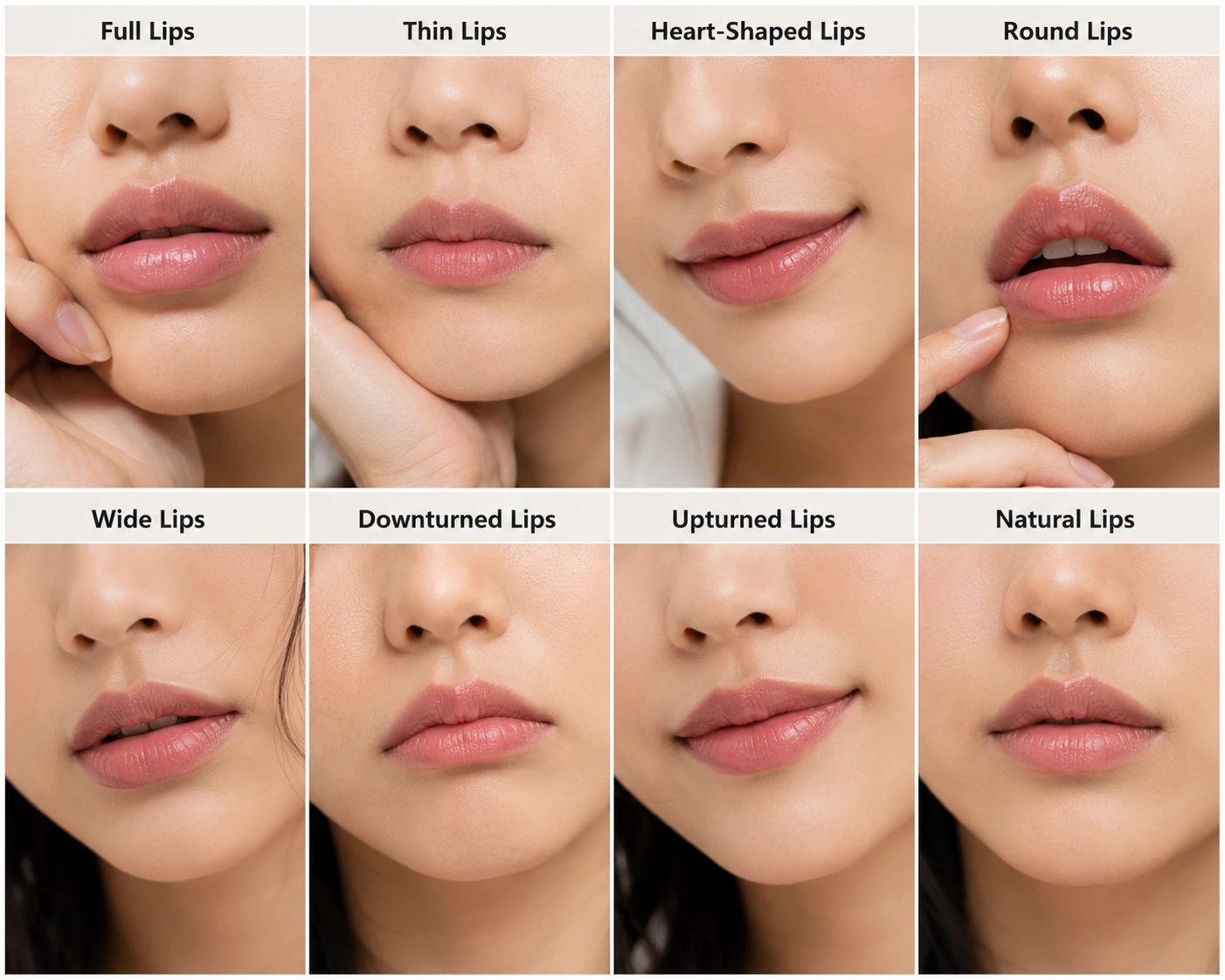
Full lips have significant volume on both the upper and lower lip, often close to an even 1:1 ratio between the two. This is one of the most sought-after shapes in filler consultations, since fullness is generally associated with a youthful appearance.
Thin Lips
Thin lips have less natural volume and a flatter vermilion border, giving them a more understated look. Thin lips can be a natural, permanent feature or can develop with age, as lips naturally lose volume over time.
Round Lips
Round lips have a soft, curved shape with less defined angles at the corners, giving an overall rounded rather than sharply outlined appearance.
Heart-Shaped Lips
Heart-shaped lips have a well-defined, pronounced Cupid’s bow, with the upper lip forming distinct peaks that create a heart-like silhouette.
Wide Lips
Wide lips extend further across the lower face, with the corners of the mouth (oral commissures) sitting further apart relative to the rest of the face.
Downturned Lips
Downturned lips have corners that angle slightly downward rather than sitting level or turning upward, which can sometimes give a resting expression that looks more serious or subdued than intended.
Uneven or Asymmetrical Lips
Almost everyone has some degree of natural asymmetry between the left and right sides of their lips, or between the upper and lower lip. This becomes a “type” in its own right when the difference is noticeable enough to be a defining feature.
Wide-Set vs. Close-Set Lips
This describes how far the vermilion border sits from the surrounding structures (nose above, chin below) rather than the lips’ width themselves, affecting how balanced the lips appear within the whole face.
Filler-Specific Lip Shape Terms
Beyond natural shape categories, a few terms are specific to cosmetic injectable trends and describe an achieved look rather than a naturally occurring shape:
- Russian lips – a technique that creates height and a flatter, more “tented” profile with a subtly defined Cupid’s bow, rather than the rounded forward projection of more traditional filler approaches
- Sausage lips – an overfilled, uniformly plump appearance across the whole lip with little definition, generally considered an outcome to avoid rather than a look to aim for
- Gull wing lips – an exaggerated, sharply upturned Cupid’s bow resembling a bird in flight, another stylized filler outcome rather than a natural shape
Knowing this distinction matters during a consultation — describing what you don’t want (for example, “not sausage lips”) is often just as useful as describing what you do want.
How to Determine Your Own Lip Shape
Look at your lips at rest (not smiling) in a mirror, ideally in good, even lighting, and consider:
- Volume ratio – does your upper and lower lip look roughly equal in fullness, or is one clearly larger?
- Cupid’s bow definition – is the double-curve at the center of your upper lip sharp and visible, or soft and barely noticeable?
- Corner angle – do the corners of your mouth sit level, turn slightly up, or turn slightly down at rest?
- Overall proportion – how does your lip width compare to the rest of your face — narrow and centered, or extending wider?
A consultation with a doctor experienced in facial assessment will look at these same factors alongside your facial proportions as a whole, which is generally far more reliable than self-assessment alone.
How Lips Change With Age (Lip Line Types)
Lips don’t just lose volume with age — the fine vertical lines that develop above the upper lip (sometimes called “lipstick lines” or perioral lines) also follow recognizable patterns. According to a classification referenced by Healthline, these lines are generally grouped into a few types: fine vertical lines running across part or all of the lip, branching Y-shaped lines, and more complex intersecting or crossed lines — with severity generally increasing with age and cumulative sun exposure. If perioral lines are your main concern rather than lip shape or volume, our broader guide on wrinkles and fine lines: causes and prevention covers the mechanisms behind this aging pattern in more depth.
Lip Shape and Dermal Filler: Matching Technique to Your Natural Shape
Quick Answer: The right filler approach depends on your starting shape and your goal — thin lips often benefit from overall volume, uneven lips from corrective balancing, downturned lips from subtle corner lifting, and already-full lips from more precise, shape-defining touch-ups rather than broad volume addition.
- Thin lips – generally benefit from an even, moderate volume increase across both lips, sometimes combined with subtle definition along the vermilion border
- Uneven or asymmetrical lips – filler can be used selectively to balance volume between sides or between the upper and lower lip, rather than adding the same amount everywhere
- Downturned lips – small, targeted filler placement near the corners can create a subtle lift, softening a resting expression that reads as more serious than intended
- Lips with a soft or undefined Cupid’s bow – filler can be used to sharpen this landmark specifically, for a more heart-shaped result, without necessarily adding much overall volume
- Already full lips – often need less volume overall and more precision — refining proportion, symmetry, or a specific area rather than broad enhancement
A good consultation should always start with your natural anatomy, not a generic “one size fits all” filler plan — this is also why results and longevity vary from person to person, covered in more detail in our guide on how long fillers last in Malaysia for different areas. If you’re also comparing filler products themselves, our comparison of dermal filler brands in Malaysia covers how different formulations behave once injected.
Frequently Asked Questions
What is the most common lip shape? Round and full lip shapes are among the most commonly described natural shapes, though genetics and ethnicity mean there’s significant natural variation, and no single shape is universally “standard.”
Can lip shape change naturally over time? Yes. Lips gradually lose volume and definition with age as collagen and elastin decline, which is why lips that were fuller in youth often appear thinner, flatter, and less defined later in life.
Is it normal to have uneven lips? Yes, very. Almost everyone has some natural asymmetry between the two sides of their lips or between the upper and lower lip — it only becomes a concern if the difference is significant enough to bother you or affect your confidence.
Do I need filler to enhance my lip shape? Not necessarily. Filler is one option for enhancing or balancing lip shape, but makeup techniques like strategic lip liner placement can also visually adjust the appearance of shape and proportion without any procedure at all.
How do I know which filler technique suits my lip shape? This is best determined during an in-person consultation, where a doctor can assess your specific anatomy — volume distribution, Cupid’s bow definition, symmetry, and facial proportions — rather than relying on generic shape categories alone.
Bottom Line
Every lip shape is different, and understanding your own — its volume distribution, Cupid’s bow definition, symmetry, and proportion — is the foundation for any filler plan that looks natural rather than generic. At CLEO clinic, our doctors assess your unique lip anatomy and facial proportions before recommending a dermal filler approach tailored to enhance your natural shape.
See our full range of treatable conditions, or book a consultation to discuss what would work best for your lips.


