
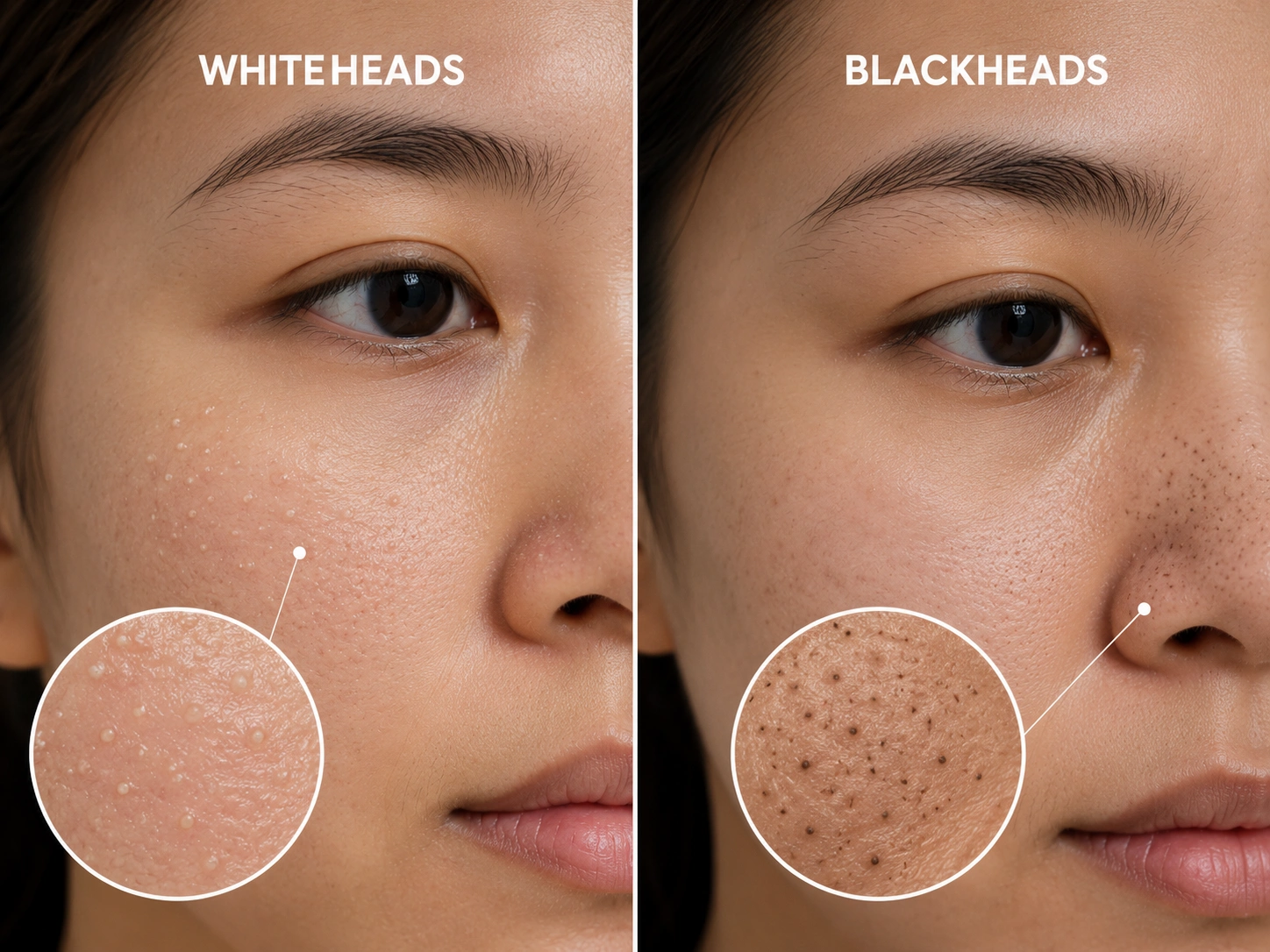

Whiteheads and blackheads are both clogged pores (comedones) caused by trapped oil and dead skin cells; the difference is that whiteheads form under a closed pore and stay white, while blackheads form in an open pore and turn dark when the trapped material oxidizes on contact with air.
They Start the Same Way
Both whiteheads and blackheads begin identically:
- A sebaceous gland produces sebum (oil) to keep the skin lubricated
- Dead skin cells build up and mix with that oil inside a hair follicle
- The mixture blocks the follicle opening, forming a clog
What happens next — whether the pore stays sealed or opens up — is what determines which type of blemish you end up with. Both are classified as non-inflammatory acne, meaning they aren’t infected or actively inflamed the way red, sore pimples are.
The Core Difference: Open vs. Closed Pore
| Whiteheads | Blackheads | |
|---|---|---|
| Medical term | Closed comedone | Open comedone |
| Pore status | Sealed shut by a thin layer of skin | Open at the surface |
| Color | White or flesh-colored | Black or dark brown |
| Why the color differs | No air reaches the clog, so no oxidation occurs | Air reaches the clog and oxidizes it, turning it dark |
| Texture | Small, raised, firm bump | Flatter, small dot-like appearance |
| Common locations | Face, especially cheeks and forehead | Nose, chin, and forehead (T-zone), also back and shoulders |
| Ease of extraction | Harder — debris is sealed beneath skin | Easier — pore is already open |
| Risk if picked at | Higher risk of irritation, scarring, or spreading bacteria | Lower risk than whiteheads, but still possible |
Why Does One Turn Dark and the Other Doesn’t?
The color difference comes down entirely to oxidation, not dirt or hygiene. In a blackhead, the pore’s opening stays exposed to air. The trapped mixture of oil and dead skin reacts with oxygen, which darkens it — the same basic chemistry as a cut apple turning brown. In a whitehead, a thin layer of skin closes over the clog, so no air ever reaches it, and the trapped material keeps its original white or yellowish tone.
Which Is Easier to Treat?
Blackheads are generally considered easier to treat because the pore is already open, giving topical ingredients and extraction tools more direct access to the clog. Whiteheads sit beneath a layer of intact skin, so they typically take longer to clear and respond better to ingredients that help the skin turn over and gradually open the pore, rather than manual extraction.
How to Treat Both
The two respond to many of the same core ingredients, though the emphasis differs slightly:
For blackheads:
- Salicylic acid to penetrate oil and clear the open pore
- Regular (not aggressive) exfoliation to prevent dead skin buildup
- Clay or charcoal masks to help absorb excess surface oil
- Professional extractions, since the open pore makes this more effective and lower-risk
For whiteheads:
- Topical retinoids to speed up skin cell turnover and help the pore resolve
- Salicylic or glycolic acid to exfoliate and help clear the follicle
- Avoiding manual extraction at home, since forcing open a closed pore raises the risk of scarring
For both:
- A gentle, non-comedogenic cleanser used twice daily
- Non-comedogenic moisturizer and sunscreen
- Consistency — most active ingredients take 6–8 weeks to show visible results
- Never squeezing or popping either type, which can push debris deeper and cause lasting marks
Can They Turn Into Each Other or Into Pimples?
Yes. A whitehead can become a blackhead if the pore eventually opens while still clogged, exposing the trapped material to air. Either type can also become an inflamed pimple (papule or pustule) if bacteria multiply inside the clogged follicle, triggering redness, swelling, and sometimes pus.
When to See a Dermatologist
Most whiteheads and blackheads respond to consistent at-home care within a few weeks. Consider seeing a dermatologist if:
- Breakouts persist despite consistent treatment for 8–12 weeks
- They’re widespread, painful, or turning into deeper, inflamed acne
- You want professional extractions rather than attempting them at home
Key Takeaway
Whiteheads and blackheads are the same type of clogged pore at different stages of exposure — closed and white, or open and oxidized to black. Both respond to similar ingredients like salicylic acid and retinoids, but blackheads are generally easier and faster to clear since the pore is already open, while whiteheads need a bit more patience.
FAQ
Which is worse, whiteheads or blackheads? Neither is medically “worse” — both are mild, non-inflammatory acne. Whiteheads are simply harder to treat since the clog is sealed beneath the skin, while blackheads are more visible but often clear faster.
Can a whitehead turn into a blackhead? Yes. If the sealed pore eventually opens while still clogged, the trapped material becomes exposed to air and oxidizes, turning the whitehead into a blackhead.
Do blackheads mean my pores are dirty? No. The dark color comes from oxidized oil and dead skin, not trapped dirt, so blackheads aren’t a sign of poor hygiene.
Lorem ipsum dolor sit amet, consectetur adipiscing elit. Ut elit tellus, luctus nec ullamcorper mattis, pulvinar dapibus leo.


