Table of Contents
- What Are Peptides for Hair Growth?
- How Peptides Are Thought to Support Hair Follicles
- Peptides Might Help, But Evidence Is Limited
- Best Peptides for Hair Growth
- GHK-Cu: Strongest Hair-Specific Evidence
- Ipamorelin and CJC-1295
- BPC-157 and TB-500
- Sermorelin
- Peptide Hair Growth Research and Clinical Evidence
- Findings From Animal and Laboratory Studies
- Human Clinical Trial Evidence
- Gaps in Current Research
- Peptide Hair Growth Safety and Side Effects
- Common Side Effects of Injectable Peptides
- Risks of Unregulated and Online-Sourced Peptides
- Who Should Avoid Peptides
- Peptide Hair Growth Products vs Proven Treatments
- Topical Peptide Serums and Shampoos
- Minoxidil and Finasteride
- Low-Level Laser Therapy and PRP for Hair
- Peptide Hair Treatment Availability in Malaysia
- Peptide Products Registered With NPRA
- Checking Product Authenticity
- When to See a Doctor for Hair Loss
- Causes of Hair Loss That Need Medical Assessment
- Frequently Asked Questions
- Do Peptides Really Grow Hair?
- Are Peptide Injections Safe for Hair Loss?
- How Long Before Peptides Show Results?
Quick answer: Peptides are often promoted for hair growth, but no peptide is approved by the FDA for hair loss, and most of the evidence comes from laboratory, animal or small studies. GHK-Cu, a copper peptide, has the most hair-related research, but large human trials are lacking. Many injectable peptides sold online are unregulated and unsafe. Proven options for hair loss include minoxidil and finasteride, and a doctor should assess the cause of your hair loss first.
What Are Peptides for Hair Growth?
Peptides are short chains of amino acids, and some are naturally present in the body. In hair products and treatments, peptides are sometimes promoted as signals that could help hair follicles grow, rest or survive. The marketing often sounds promising, but the research behind most of these claims is far less certain than the advertising suggests.
How Peptides Are Thought to Support Hair Follicles
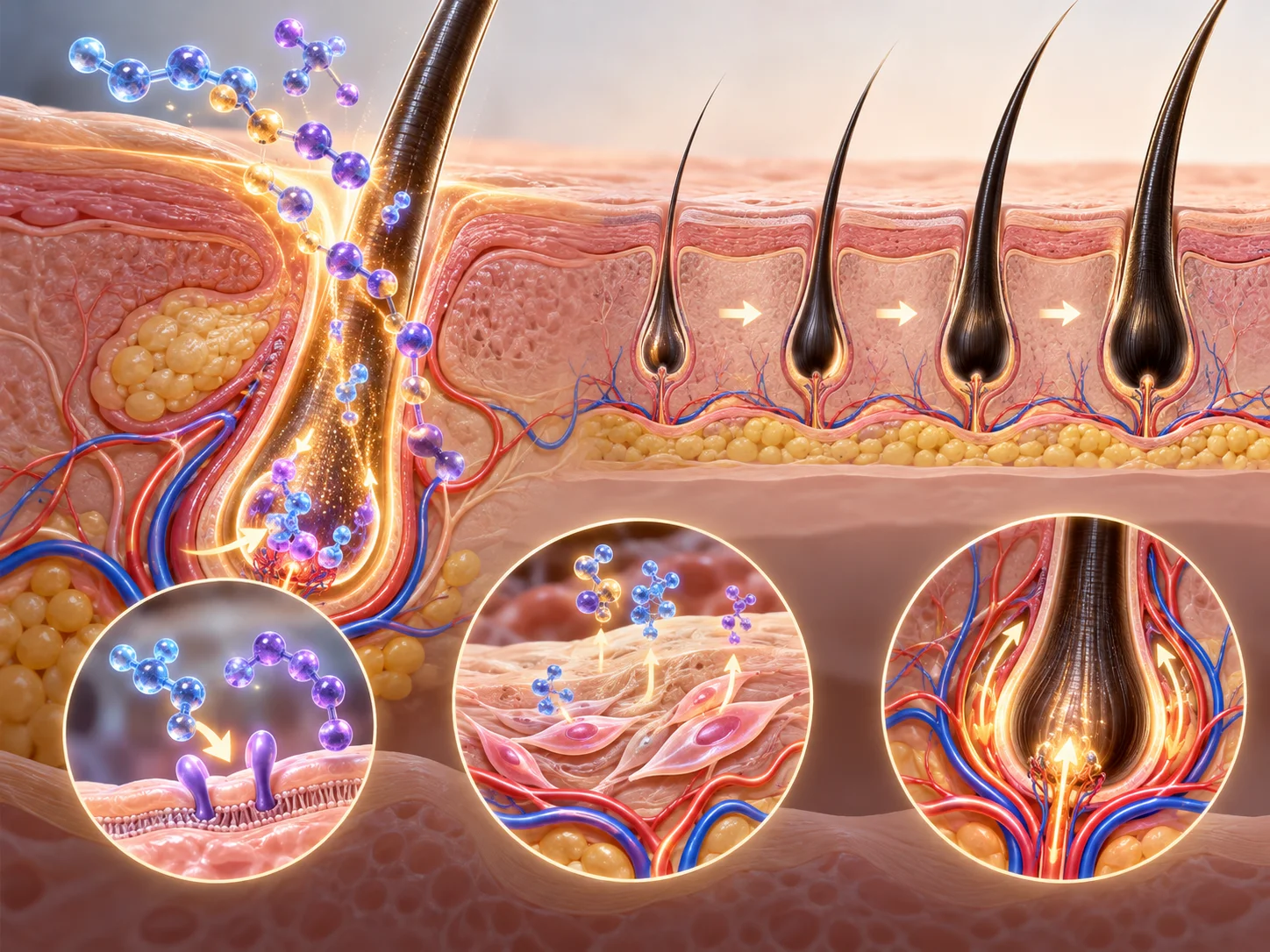
Researchers have studied peptides that may influence follicle activity, blood supply to the follicle, inflammation, or the signalling pathways that control the hair growth cycle. These mechanisms are biologically plausible, but a mechanism alone does not show that a product grows hair in people. A useful way to think about hair peptides is to ask whether a study has tested the product on people with the same type of hair loss, and measured hair count or density.
Peptides Might Help, But Evidence Is Limited
For most peptides, the evidence comes from cell studies, animal models or small human studies with different designs. Results are often reported as scalp changes, rather than measured hair counts. This means peptides may help in some situations, but they should not be treated as a proven replacement for established hair loss treatment.
Best Peptides for Hair Growth
The peptides below are the ones most often discussed. None is approved by the FDA for hair loss, and the ranking reflects how much hair-related research exists, not whether the peptide works for everyone.
GHK-Cu: Strongest Hair-Specific Evidence
GHK-Cu is a copper tripeptide that occurs naturally in the body. It is the most studied peptide for hair, with laboratory and ex vivo human follicle data, and some research on scalp tissue. Human evidence is still limited, and large randomised trials measuring hair count and density have not been published. Topical GHK-Cu products are sold as cosmetics in many countries, so their quality and concentration can vary. For a deeper look at this peptide, read our GHK-Cu copper peptide guide.
Ipamorelin and CJC-1295
Ipamorelin and CJC-1295 are growth hormone-releasing peptides, mainly studied for their effect on growth hormone levels. They are not approved for hair loss, and there is no human evidence that they grow hair. Some products sold online are labelled for research only, which means their dose, purity and safety are not controlled for human use.
BPC-157 and TB-500
BPC-157 and TB-500 (thymosin beta-4 fragments) have been studied for tissue repair in animals. Neither is approved for hair loss, and there are no published human studies for hair growth. BPC-157 is also prohibited in sport under anti-doping rules, so athletes should not use it. Human safety data for these peptides are very limited.
Sermorelin
Sermorelin is a growth hormone-releasing peptide used in some countries for specific hormone conditions. It is not approved for hair growth, and there is no reliable evidence that it helps hair loss. Any use should be under a doctor’s direct supervision for an approved indication.
Peptide Hair Growth Research and Clinical Evidence
Findings From Animal and Laboratory Studies
Laboratory and animal studies have explored how peptides may affect follicle cells, scalp blood supply and inflammation. Some of these findings are promising, but animal results often do not translate directly to people, and laboratory conditions are very different from scalp treatment.
Human Clinical Trial Evidence
Human evidence for peptide hair products is limited. The studies that exist tend to be small, short or not designed to measure hair count or density in people with pattern hair loss. Where human data do exist, they often combine peptides with other ingredients, which makes it hard to know what caused any change. Read our guide to what peptides are and how the evidence is judged for more detail.
Gaps in Current Research
- Few large, well-designed human trials of peptides for hair growth
- Limited data on long-term safety, especially for injected peptides
- Inconsistent product quality, concentration and purity
- Limited data for people with darker skin or different hair types
- Marketing that often goes beyond the published evidence
Peptide Hair Growth Safety and Side Effects
Common Side Effects of Injectable Peptides
Injectable peptides can cause injection-site redness, swelling, pain and bruising. Some people experience nausea, headache, dizziness, flushing or changes in appetite. Because long-term safety data are limited, side effects may not be fully known.
Risks of Unregulated and Online-Sourced Peptides
Peptides bought online or from unlicensed sellers may contain the wrong ingredient, the wrong dose, contaminants or bacteria. Injecting an unregulated product carries risks of infection, allergic reactions and serious harm. Products labelled ‘for research use only’ are not intended for human use. If you have used an unregulated peptide and feel unwell, seek medical care promptly.
Who Should Avoid Peptides
Speak to a doctor before using any peptide if you are pregnant or breastfeeding, have a history of cancer, have diabetes or an endocrine condition, have a bleeding disorder or take blood thinners, have an active infection, or take other medicines. Athletes subject to anti-doping rules should not use prohibited peptides.
Peptide Hair Growth Products vs Proven Treatments
Topical Peptide Serums and Shampoos
Topical peptide serums and shampoos are usually cosmetic products. They may condition the scalp or support hair appearance, but they are not proven to regrow hair in the way prescription treatments are. Use them as a supportive step, not as a replacement for proven treatment.
Minoxidil and Finasteride
Minoxidil and finasteride are established treatments for pattern hair loss. Both have strong clinical evidence and are used worldwide. Minoxidil is applied to the scalp, and finasteride is a prescription tablet that works by reducing DHT. Read our guides to topical minoxidil 2% vs 5% and how finasteride works. For a full treatment overview, see our minoxidil and finasteride hair loss treatment page.
Low-Level Laser Therapy and PRP for Hair
Low-level laser devices and platelet-rich plasma (PRP) have been studied for hair loss, but the evidence is mixed and treatment protocols vary. PRP is an option some doctors offer alongside established treatment. Read our guides to PRP for hair loss and PRP compared with minoxidil, finasteride and dutasteride.
Peptide Hair Treatment Availability in Malaysia
Peptide Products Registered With NPRA
We have not found a peptide product that is registered in Malaysia specifically for hair growth. Before buying any product, search the NPRA product database and check the registration number and approved indication. A product sold as a cosmetic or research chemical is not the same as a registered medicine.
Checking Product Authenticity
- Check the NPRA registration number and the approved use on the packaging.
- Be cautious of very low prices, unknown sellers and social media offers.
- Avoid products labelled ‘for research use only’ for human use.
- Buy medicines only through a licensed pharmacy or a registered clinic.
- Keep packaging and receipts if a problem occurs.
When to See a Doctor for Hair Loss
Causes of Hair Loss That Need Medical Assessment
Hair loss can have many causes, and not all of them respond to the same treatment. See a doctor if you notice sudden or patchy hair loss, scalp pain, scaling or redness, rapid thinning, or hair loss after illness, childbirth, surgery or a change in medicine. Thyroid problems, iron deficiency, hormonal conditions such as PCOS, and some medicines can all cause hair loss.
For a broader look at the causes and what can help, read our guides to hair fall causes and treatments, female pattern hair loss and rambut gugur: punca, tanda dan rawatan.
To discuss your hair loss and the right treatment for your cause, contact CLEO clinic or read about our doctors.
Frequently Asked Questions
Do Peptides Really Grow Hair?
The evidence is limited. GHK-Cu has the most hair-related research, but large human trials measuring hair count are lacking. No peptide is FDA-approved for hair loss, so results should not be promised.
Are Peptide Injections Safe for Hair Loss?
Injectable peptides carry risks, including infection and unknown long-term effects. Unregulated products are particularly risky. Discuss any injectable with a registered doctor before use.
How Long Before Peptides Show Results?
Hair grows slowly, so any change would take several months to become visible. Proven treatments such as minoxidil and finasteride also take months, and a doctor can set realistic expectations for your case.
Disclaimer: The information on this page is for educational and informational purposes only and does not constitute medical advice or establish a doctor-patient relationship. Peptides for hair growth are not approved for this use by the FDA, and their benefits and risks are not well established. Do not use unregulated or research-only peptides. Please consult a qualified healthcare professional for a medical assessment before treatment.